Linda's Lunacy

Faith, Home, & Family

  • Home
  • ABC’s
  • Childhood Cancer Awareness Resources
  • Gardening
  • Giveaway Linky List
  • Gluten Free
  • Homeschool
  • In the Kitchen with Linda
  • Home
  • About Linda
  • Disclosure & Privacy Policy
  • PR Friendly
  • Get My Button

Zane Education Review

July 29, 2012 by Linda @ Linda's Lunacy

As part of the Schoolhouse Review Crew, I received a 12 month Gold membership to the Zane Education website.


Photobucket


The Zane Education website offers 1544 videos on 384 topics for elementary, middle school, high school, college and adults. They also have lesson plans and quizzes.


Zane Education

The essential and ultra-affordable visual learning solution for home education that caters for each learning style.

Single subscription per family slashes cost to homeschool.

Enables students to study each topic effectively PLUS improve their reading and literacy skills at the same time.

Enables each child to study at their own speed, achieve their greatest potential and develop interest in their study.

Excellent homework help and revision aid and The Modern Tutor’s “Best Friend”


There are several ways you can use the website. You can view the videos by subject and topic. Choosing what you need for what your studying. You can also watch the videos by grade. The videos are divided into elementary, middle, high school, college and adult sections.  It’s easy to find an appropriate video for your elementary student, say, instead of having to scroll through all of the videos to find one.

There are quite a few guides to help you get the most out of the videos. There are free User Guides available to download. Guides for traditional education and homeschool. Including several for Special Needs and English as a second language. The Video Catalogue and the Math Catalogue are pdf’s that list all of the videos available on the site, arranged by subject. The Learning Video Catalogue ebook, available for purchase or free with annual membership, is an indepth introduction to all 260 topics and subjects except for math. Also available is the Christian Home Learning Guide ebook.

Zane education is not a Christian site. There are several videos that refer to evolution. Just so your aware. They do have a few videos under the heading Religious Studies. They also have a Christian Home Learning Guide available. This is a great resource to have when using Zane. There is a really cool Timeline of Christian History included in the guide. The timeline starts with Adam & Eve and goes up to 1991. I will be printing the timeline out. The guide is divided by subject, with a listing of all the videos. Then there are several pages of articles on the subject. Followed by Scripture references, review questions, and suggested reading. The guide is available for purchase, or in some instances, free. See pricing below for more information.


Photobucket


The online educational videos are subtitled so the student can read along with the audio. This helps with their reading skills, also. It also means that kids with different learning styles can all watch the same video and learn the way they do best.

The website is easy to navigate. Older students will be able to access the videos themselves. Some younger students will be able to do it, too. There are a few health videos that you might not want younger students to watch, so you might want to be nearby to make sure they don’t go there.


Photobucket


There are online quizzes available for every video, except for the math videos. There are 23,000 curriculum-based questions throughout all the quizzes. The quizzes align with State and National Standards. At the end of every quiz, it is explained to the student why each answer was correct or incorrect. The site does not keep track of your quiz scores for you. At the end of each quiz, you can either print the results or email them to yourself. You could also keep a notebook for each student and record their grades in it.

The Study Centre is full of educational helps for the students. A dictionary, an encyclopedia, a thesaurus, a really neat video glossary and more. These are great to use not only while learning from the videos, but when the students are doing book work as well.

My kids liked that they could pick the subject they wanted to work on. They liked the videos they watched. They didn’t really care for the ones with writing on the screen the whole time, though, which I understand. We will continue to use Zane Education for this school year to go along with what we’re studying or to let the kids explore new topics.

While the subscriptions can be a bit pricey, if you have a student that learns better visually, this may be a good fit for your family. My suggestion is to go view the free videos, the demos and the math videos, so you can get an idea of how your family will use it. Then you can pick the least expensive membership that will work for your family. Or you may be like me, and have enough students to make the Gold membership worthwhile.

Zane Education offers several different pricing options.

-Free membership – access to the demo videos, ALL the math videos, and all the quizzes.

-Topic Taster – $5. a month- Same as free plus all the videos on one topic.

-Bronze – $8.99 a month or $98.89 a year – Same as free plus all videos by grade.

-Silver – $12.99 a month or $142.89 – Same as free plus all videos by subject.

-Gold – $17.99 a month or $197.89 – Same as free plus ALL the videos by topic, grade and subject. Plus the Christian Learning Guide and the Zane Home Learning Guide for free.

-The Zane Home Learning Guide and the Christian Learning Guide can be purchased for $49.95 each or are free with a one year subscription.


Zane Education is offering a 35% discount on the purchase of any annual 12-month Gold, Silver or BronzeMembership subscription through until the end of August 2012. Use Discount Promotion Code: ZE265HSM

 

Photobucket


*Disclosure of Material Connection: I received online access to Zane Education  in the hope that I would mention it on my blog. Regardless, I only recommend products or services I use personally and believe will be good for my readers. My opinions are my own. I am disclosing this in accordance with the Federal Trade Commission’s 16 CFR, Part 255: “Guides Concerning the Use of Endorsements and Testimonials in Advertising.”


Filed Under: Homeschool Reviews

Saturday on the Farm

July 28, 2012 by Linda @ Linda's Lunacy

There’s not a lot going on around here farm wise. It’s been such a hot, dry summer here in Kentucky. We’ve finally been getting rain the last couple of weeks. So everything is starting to grow again.

I haven’t been physically able to get out and work in the gardens, so they are suffering from neglect, too. sigh. I have some lettuce and a couple of cucumbers ready. The cucumbers are from a volunteer plant that grew from the compost. The cucumbers in the garden aren’t ready yet.

As a surprise to me, the Hibiscus plants bounced back after all our storms and high winds. this is our biggest one. I really need to divide it. It’s still blooming for me, too.  🙂

Hibiscus

This second Hibiscus is mostly standing and still blooming, too.

Hibiscus

This third Hibiscus has taken the brunt of the winds. As you can see, it’s not going to let the wind stop it, and it’s still blooming.

Hibiscus

We got a late start on our garden this year. The green beans are getting big, but no blossoms as of a couple of days ago. There is 4 rows, one on each side of the two fences.  We get quite a bit of beans from this. I used to freeze them, but now that I have a pressure canner, I can them.

green bean

Can’t wait for fresh green beans!


[Read more…]

Filed Under: Saturday on the Farm

Our Homeschool Week in Review

July 27, 2012 by Linda @ Linda's Lunacy

The Olympics are here! I love using the Olympics for school. I have since we started homeschooling in 1991. (yes, I’m old! lol) Since I had so much information to share about homeschooling and the Olympics, I put it all in a separate post, Homeschooling and the 2012 Olymmpics. Stop by and see what we do!

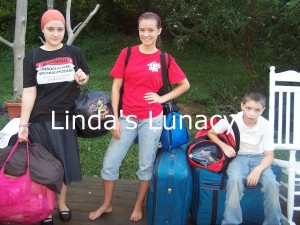
The three youngest kids have all been at sleep away church camp this week. It sure has been quiet around here! When they left Monday morning:

I sure have missed them and can’t wait until they get home tonight!

Before she left, Hannah made a toiletries case she had seen on Pinterest.  Here it’s rolled for the suitcase.

handmade toiletries case

And open, it has 3 “slots”. You could also put more “slots” in if you wanted. It depends on the size of the items you’ll be putting in it. Very clever and I think she did a great job!

handmade toiletries case

Monday is back to school for us! First up is sending in our homeschool notification letter. Since the Olympics coincide with our back to school dates, we won’t be starting a full load of book work until the Olympics are over. We’ll concentrate on the unit studies, lapbooks and activities for the Olympics. As well as items we are working on for reviews.
I posted a review last week for Super Duper Publications Hear Builder Auditory Memory. If you looking for a way to increase your children’s auditory memory, check it out. I also posted a review for Knowledge Quest TimeMaps. Very cool!


To see more homeschooling posts, visit Weekly Wrap Up.

Filed Under: Homeschool

Homeschooling with the Olympics

July 25, 2012 by Linda @ Linda's Lunacy

*This Homeschooling with the Olympics post contains affiliate links

The Olympic games are great fun to watch. They can also be a great learning experience for the kids and the whole family. We always do an Olympics unit study. We learn about the food and customs of the host country. Sometimes we have learn the rules for new sports. How much time you spend on this will depend on your family and the age of your kids.

Homeschooling With the Olympics

We always spend time learning about the host country, which is England this year (the year this was originally written!). A study of  England will naturally lead to the independence of the United States. You can cover both World History and United States History at a level appropriate for your kids.

As interesting things come up during the Olympics, we learn about other countries. I like to keep a globe in the room with us while we are watching the Opening Ceremonies. That makes it easy for the whole family to see where the countries are located. Don’t have a globe? Use the computer to look the countries up. You’ll actually get more information about the countries that way.

We’re also making lapbooks this year. Yes, even the teenagers! The one we’re using (linked below) is for high school, too.

Another fun learning activity is for each child to pick a country to root for. They can learn about that country and share with the rest of the family. Have the kids keep track of the medals won by their countries by making a chart.

Homeschooling with the Olympics – Decorating

We also love to decorate for the Olympics. Pull out any flags that you have and the room will feel festive right away. Paper chains are fun to make and hang across doorways or windows. Use red, white, and blue or the colors of the Olympic rings. There are several links below that have coloring pages that can be hung as decorations. One year, I had the kids draw different world flags on index cards and hung them up. The kids loved it when they recognized a flag they had drawn while watching the Olympics.

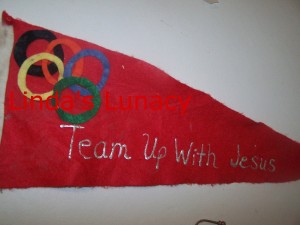
Here’s my favorite Olympic decoration that we have.

Olympics flag decoration

It’s a pennant made in Vacation Bible School by one of my two oldest kids. This was made in 1992, and we’ve used it every Olympics since then. It would be very easy to recreate. Red felt, white felt on the left hand side had a dowel glued to it. The rings are also made out of felt. The words are silver fabric paint.

Check the Linda’s Lunacy Olympics Board on Pinterest for more decorating ideas.

Homeschooling with the Olympics – Food

As part of our Olympics study, we always try a few foods from the host country. China and Italy have been some of our favorites. Two dishes that are popular in England are fish and chips, and bangers and mash.

Fish and chips are breaded, fried fish and french fries. Use your favorite fish and make some fries. Kids will only eat fish sticks? That’s ok. You can still serve them with french fries (from the freezer section, too, if you want).

Bangers and mash are sausages and mashed potatoes. Another easy meal. Serve your favorite sausage with your favorite mashed potatoes. Make sure to tell the kids they’re bangers and mash, though. An interesting tidbit, during the war, the sausages were made with less meat and with added water. So when the sausages were cooking, the water would explode and they would “bang”, and that’s when they started calling them bangers. (That’s from a video I watched online on how to make bangers and mash.)

There are a lot of ideas for Olympics food on Pinterest, I have several pinned.

Amanda Bennett has a great unit study titled Olympics: History, Geography, & Sports.

*NOTE: This post contains affiliate links. If you click through and buy something, I will earn a small commission.

Filed Under: Homeschool Tagged With: homeschool, Olympics

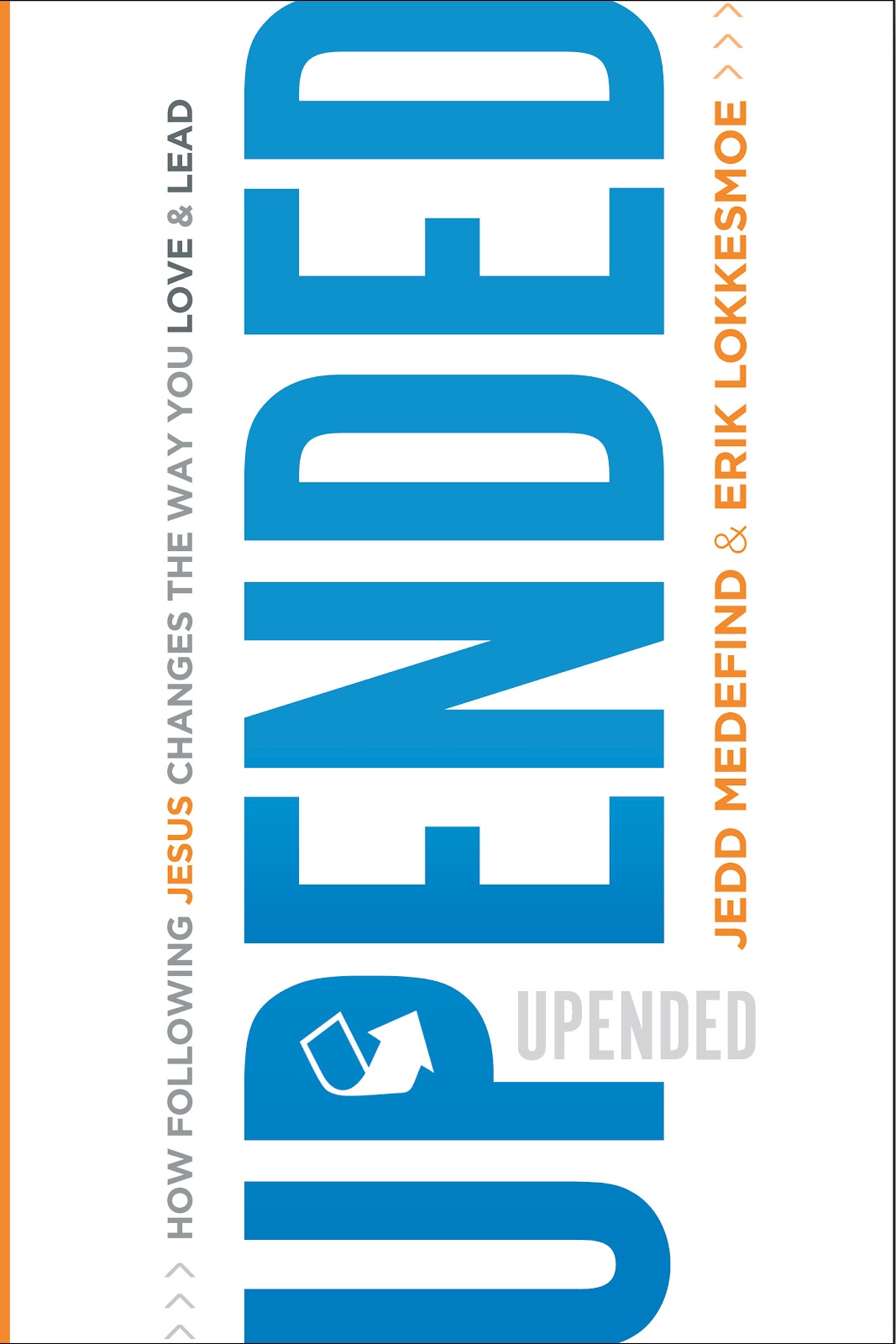
Upended: How Following Jesus Remakes Your Words and World

July 25, 2012 by Linda @ Linda's Lunacy

It is time for a FIRST Wild Card Tour book review! If you wish to join the FIRST blog alliance, just click the button. We are a group of reviewers who tour Christian books. A Wild Card post includes a brief bio of the author and a full chapter from each book toured. The reason it is called a FIRST Wild Card Tour is that you never know if the book will be fiction, non~fiction, for young, or for old…or for somewhere in between! Enjoy your free peek into the book!

You never know when I might play a wild card on you!

Today’s Wild Card authors are:


Jedd Medefind 

and

Erik Lokkesmoe


and the book:


Upended: How following Jesus remakes your words and world
Passio (May 1, 2012)

***Special thanks to Althea Thompson | Publicity Coordinator, Charisma House | Charisma Media for sending me a review copy.***

ABOUT THE AUTHORS:

Jedd Medefind serves as president of the Christian Alliance for Orphans. Prior to this role, he led the White House Office of Faith-Based and Community Initiatives as a special assistant to President George W. Bush. He and his wife, Rachel, love the great outdoors and have four children. Hometown: Los Angeles, CA
Visit the author’s website.

Erik Lokkesmoe is the founder and principal of Different Drummer, a LA/NYC-based audience and fan mobilization agency for top entertainment brands. Erik has a MA in public communications and a BA in political science. Erik and his wife, Monica, have three children. Hometown: New York, NY

Visit the author’s website.

SHORT BOOK DESCRIPTION:

Christians follow a Man who upends our most basic assumptions and expectations at every turn. Yet for many of us who claim to follow Him, our lives are not peculiar at all. If anything, we are a rather predictable people. We follow an upside-down God yet live right-side-up lives.

Yes, we often hear calls to more radical living. Sometimes we yearn for it. But often “radical” ends up being just an idea. But apprenticeship to Jesus is often far more costly. That’s why this book isn’t about big choices that make us radical. It’s mostly about small choices that begin to mirror the life of One who was radical indeed.

Product Details:

List Price: $14.99

Paperback: 240 pages

Publisher: Passio (May 1, 2012)

Language: English

ISBN-10: 1616386053

ISBN-13: 978-1616386054

AND NOW…THE FIRST CHAPTER:

C h ap t e r 1

Eternal Truth and the Daily Grind

Most of the genocides of the twentieth century—from Communist Russia to China to Cambodia—were led by avowedly atheist gov- ernments. Often, pastors and priests were among the first killed. But the story of Rwanda’s genocide is more complex. Yes, many faithful Christian leaders were targeted for immediate death. But in 1994, when the horrific events of one hundred days took an estimated eight hundred thousand

lives, roughly 90 percent of Rwandans claimed to be Christians.

Experiencing the pictures and stories of the genocide in the Kigali Memorial Centre today, a thoughtful Christian cannot help but question in anguish, “How is this possible in any nation, let alone one that was sup- posedly so Christian?”

Rwandan pastor Antoine Rutayisire has grappled with this question himself. He experienced the searing pain of the genocide firsthand. In both anger and grief he explored what enabled such a profound gulf between professed religion and what played out in practice.

At the heart of the matter Rutayisire has concluded that the Christianity of most Rwandans was totally divorced from their ordinary lives. It had to do with heaven, but not earth; abstract doctrines, but not daily choices. Rutayisire explains how traditional African religions always carried implications for virtually every task and interaction, from animal husbandry to cooking. The imported Christianity that took root in much of Rwanda, in contrast, was “a kind of catechism based on memory but not touching issues of daily life.”

The issue was not simply that many Rwandans did not take religion seriously or didn’t carry sincere religious beliefs. Most all Africans do. The issue was that their Christianity carried almost no consequence for the small choices they made every day. The missionaries had taught cate- chisms and rituals, but not how Jesus would want them to manage a busi-

ness or interact with their neighbors.

|    11 |

Rutayisire explains, “The consequence was that many people got bap- tized and integrated into churches, but every time when they ran into prob- lems, they fell back into traditional religion. . . . And in terms of conflict, they relied on what they had been taught by their fathers.”1

It is easy to view the savagery of Rwanda’s genocide and imagine it has nothing to do with us. But the simple truth is that the Christianity prac- ticed by many self-described Christians worldwide is not all that different from the religion practiced by the many Rwandans who failed to stop, or who even participated in, the genocide. It is a religion of great truths and noble ideas that remain largely disconnected from daily choices.

Even those of us who take our faith seriously can fall into the same trap, allowing gaps to form between Christian conviction and the activities of daily life. We study and explore doctrinal truths, but we often feel at a loss to explain how they affect the way we converse with friends, serve our boss, or invest retirement funds. We lack practical connection points  between Christianity’s big ideas and what we do each day.

Like that of many Rwandans at the time of the genocide, our religion may feel real enough in the life of the mind. As Rutayisire would say, we have been baptized and integrated into churches. But we have not learned what it looks like to “walk as Jesus did.”2 So when practical decisions must be made, we fall back on habits and learning that really have little to do with the ways of Jesus. When tested, such religion disconnected from daily life is found profoundly lacking, whether in school or work, marriage or wider social engagement—just as it was in Rwanda.

the  fataL  spLit

Disconnecting Christian faith from daily experiences is not just unfortu- nate. It is deadly. We see its effects on a grand scale in the breathtaking evil of genocide, but just as surely in the withering of once-rich friendships, marriages grown cold, or children estranged.

Over a lifetime the disconnect becomes a trail of opportunities squan- dered. It is the possibility of living vibrantly, loving well, and leading in ways that leave lasting impact . . . lost forever.

At times even Christian teachers have encouraged this fatal split. They have elevated a higher realm of religious knowledge and activity above the lower  realm of everyday life. But this view has no basis in Jesus or the apos- tles, nor the Old Testament either.3 Rather it was Greek philosophers and Gnostics who tried to divorce the spiritual from the physical. For them

abstract ideas were superior to the world around us. So spiritual progress required moving away  from physical things. Their goal was to transcend the mess and muck of the ordinary.

In contrast, Christianity—like Judaism before it—affirmed that all God made was “very good.”4  Paul summed it up well to Timothy: “For every- thing God created is good, and nothing is to be rejected if it is received with thanksgiving.”5  This includes work and recreation, food and wine, sex and friendship.

Yes, sin has marred these things profoundly. But God’s response is not to abandon or transcend ordinary, physical things. Rather, His plan from the start was to enter  His creation in order to repair, renew, and restore.6

That same pattern is God’s call to His people as well. We are to take His truth and vitality into each day’s activities and interactions, just as Jesus did. Learning how to do so from Jesus is the lifelong adventure of the apprentice.

Though exceptional, there were many in Rwanda in 1994 who’d embraced this vision too. One was Celestin Musekura. As a pastor he’d sought both to teach and to live a practical, daily apprenticeship to Jesus. When the 1994 genocide began in his home country, he was completing his graduate studies in Kenya. While most everyone who could was rushing pell-mell out of Rwanda, Celestin headed in, risking his life to try to turn his fellow Hutu tribesmen from murder and to exhort Tutsis to resist the urge for revenge.

There were others too. As evil surged around them, they refused to par- ticipate or look the other way. Some hid neighbors in their homes. Others stared down machete-wielding mobs. Many died for their efforts to pro- tect innocent life. But they’d learned long before how to weld together eternal truth and their daily choices—and they continued to do so, even at immense cost.

Today, with anguish from the genocide yet pungent in Rwanda, Celestin and others like him continue to live as apprentices to Jesus. Though still mourning profound loss, they forgive those who killed their dear friends, family members, and neighbors. Risking the hatred of their own tribes members, they build reconciliation in their communities and churches. Slowly they are reweaving the fabric of Rwanda.

Explains Celestin, “Amidst the bloody history of tribal hatred, Africa’s only hope lies in a Christianity that pervades our lives down to the smallest

things, when our identity in Christ supersedes our tribal identity. It is costly. But the alternative costs even more.”7

Can  We reaLLy  do it  today?

Living two thousand years away from Jesus’s time on earth, it may seem overblown to speak of actually becoming an apprentice to Him. Looking closer, however, we realize that the experience of Jesus’s first apprentices is not as different from ours as we might think.

Paul, like us, never walked with Jesus. Yes, the twelve disciples did have the privilege of observing Jesus in person. But it was only for three short years. And truth be told, they didn’t do particularly well as apprentices while Jesus was still with them. It was only after Jesus’s departure, when they were in much the same situation we are now, that they really began to look like His apprentices in their attitudes and actions.

For them and all who’ve followed since, the core of apprenticeship has always been the same. Responding to God’s grace and empowered by His Spirit, the apprentice marks the words and ways of the Master—and then puts them into practice.

Follow Me, Jesus offers to us too. It is a summons to learn not just about

Him but also from Him.

Person a l Note s:  Jedd

With college graduation nearing, law school seemed the next logical step for a guy who didn’t have the prerequisites for any other graduate studies. But talking with many who’d walked that road gave me pause. So few loved what they did. The grinding hours at big firms brought fat paychecks but seemed to snuff out enthusiasm and purpose.

Three close friends of mine were grappling with similar thoughts. We each wanted badly to engage the world fully and experience Christ’s life to the full. Just as much, we feared that the ladder of success might lead to far less than we hoped for out of life.

So, with a blend of hope and desperation, we put grad school and pay- checks on hold. Instead, we’d spend the year living with and learning from committed Christians around the  globe—people who served God and neighbor faithfully in their own native lands. Most of all, we hoped to taste life at its fullest . . . and learn how to keep that going for five or six decades. The months ahead were indeed the adventure of a lifetime: from the Guatemalan highlands to Russia’s frozen north, Africa’s mountain kingdom

to the endless rice fields of Bangladesh.

But there was a sobering element too. No matter how thrilling a place was when we first arrived, we were struck by how quickly exciting wears off. Adrenaline ebbs. Exotic becomes commonplace. We saw with dismal

clarity that the life  to the full we sought wouldn’t be found in relentless adventure alone.

Yet  alongside this realization, hope glimmered. It  wasn’t in  the buzz of novelty or grand exploits but in a number of the local Christians we served alongside. Their work and relationships weren’t exotic to them. Many had done what they were doing for years. They delivered medical care to Guatemalan peasants; taught wrestling and Jesus in Russian orphanages; created simple business opportunities for the poor in Thailand; led secret house churches in Communist Vietnam. Their work and daily choices were mostly quiet, steady. Some weren’t in full-time ministry at all. Yet their days blazed with the kind of purpose and humble joy we hoped would fill ours to our last breath. With countless small choices to follow Jesus, they infused daily life with eternal life.

That journey taught us more than we could recount. But what I most pray will shape my choices is still that simple realization. Life to the full isn’t found out there —in far-off adventure, or a much-anticipated change, or the next stage in life. Rather, it’s found in ordinary places and daily choices to love and give and serve with abandon for Christ’s sake.
not  MereLy  a huMan  pursuit

We must know from the start that apprenticeship is not merely a human pursuit. Its wellspring is always response to God’s grace. It is surrounded by faithful witnesses from every generation. It is engaged as part of a com- munity, both local and global, called the church. It is nourished continu- ally by God’s living Word. It is undertaken with a continual sense of gift, never earning or merit.

Perhaps most importantly, Jesus promised His apprentices a mighty Helper.  The Holy Spirit works continually, both within and alongside the true apprentice. He  encourages, convicts, provokes, guides, enlightens. Apart from the Spirit, our labors become wearisome toil. But as we wel- come His labor inside and around us, beauty and good fruit spring from even our most feeble efforts.

The fact that apprenticeship to Jesus is not merely a human pursuit, however, does not mean that it happens apart from the human choices that go into most any other form of apprenticeship. We would not imagine we could become an excellent chef or doctor or painter simply by waiting for it to happen to us. Nor can we if we desire to become like Jesus.

We must learn from Him how to do so via practical, daily, real-world decisions. Choice by choice we participate with the Holy Spirit in bringing our understanding, character, and daily actions into alignment with those of the Master.8

This book explores just one facet of this apprenticeship: how we commu- nicate. Yet there may be no better place to begin. For we are all communi- cators, and how we do so shapes both the quality and outcomes of virtually everything we do. If we can become a true apprentice of Jesus in this, it will touch every relationship and undertaking.

The approach we will  take together is straightforward. Like Jesus’s apprentices in every age, we study the words and ways of the Master recorded in the Gospels and amplified in all of Scripture. We take special note of how He spoke and served through speech, how He listened and led, how He connected and conveyed. We consider carefully how what we see can be reflected in our daily choices. We learn from others too who have done the same before us.

All of this we offer frequently to God in prayer. We ask from Him more- than-human insight and perseverance. We invite the vivifying, guiding presence of the Holy Spirit. Then, ideally as part of a community that shares our commitment, we put what we see into practice.

If we are ever to connect the lofty convictions we claim with what we do day in and day out, this is where we must begin. Here we start to knit together eternal truth with our jobs and parenting, marriage and friendships. Over time every interaction increasingly reflects the heart

the Master.

graCe  and effort

Person a l Note s:  Jedd

My dad was twenty-one when he first donned the flat-brimmed hat of a Yosemite  ranger. Never had he wanted anything more. But learning the ropes in 1969 was nothing like the myriad classes and certifications that novice rangers undergo today. Instead, Dad was paired with a veteran ranger and sent out to learn in action.

He hadn’t been on the force long when the old-timer he’d been paired

with, Ranger Utterback, slid from their parked patrol car into the night. “We’re seeing a lot of drugs used and sold in this camping area,” explained Utterback. He held up his hand as Dad began to follow. “Leave the hat in the car. Too obvious.”

Raucous laughter drew them through the darkness to a group gathered around a fire on the edge of camp. Dad followed as Utterback moved into a space shadowed by a large pine. Marijuana smoke hung dense in night air. In those days even possession of the drug was a felony.

As Utterback prepared to step into the firelight, Dad stopped him. “I’ve never made an arrest,” he warned.

“Just watch what I do and do what I do,” whispered Utterback.

That phrase became the theme of the summer, from serving arrest war- rants to chasing break-in bears out of cabins. Dad watched, then replicated. Looking back, he describes, “Rangers joining the force today have some advantages in all the formal training.”  However, he observes, “when  you learned by putting on the uniform and following a veteran, you saw how to do it. The things you can’t get from a book or a class. How to convince a hostile crowd to cooperate, calm down a hurt child, or scare off a bear with- out hurting it. If you have the desire, you absorb all of this from the veteran

in the field in a way you just can’t fully learn in a classroom.”

Riding horse patrol one morning with  another veteran ranger, Don Pimontel, Dad encountered one of the most beautiful scenes he’d ever laid eyes on. As the two men crested a mountain pass, the snow-laden peaks of Yosemite’s vast north country rose ahead of them. Overhead, thunder- heads billowed heavenward, painted with every shade of dark and light. Immediately below opened a meadow, fragrant and glowing purple in a sea of lupine flowers.

Dad sat on his horse, awash in wonder. Unexpectedly, tears began to fill his eyes. He pushed them back and set his jaw as he imagined a ranger ought. But when he glanced over at Ranger Pimontel, that illusion was ban- ished forever. Pimontel’s leathered face glistened, wet with tears.

“I didn’t just learn from him there; I felt with him,” Dad shared with me decades later, “I knew it was OK to feel the beauty. God’s beauty.”

Dad learned that summer not just as a student but as an apprentice. Facts and information were certainly part of the training. But the most important elements went deeper. The veteran rangers like Utterback and Pimontel provided what no classroom teacher could. This included habits and skills Dad had not possessed before, which increasingly became second nature. Perhaps even more significant, they conveyed new perspectives,  commit- ments, and even intuition. The veterans’ time-tested  ways of protecting and serving could hardly be put into words; yet they were passed from one gen- eration of rangers to another as Dad carefully observed and then put them into practice.
The intentionality and effort suggested by the term apprentice may make some Christians uncomfortable. Sometimes this discomfort is little more than a slumbering spirit; we may not like the idea of putting serious disci- pline into changing behavior and beliefs that we feel are good  enough. Or there may also be another, more legitimate discomfort. Does an emphasis on our role and our disciplines of apprenticeship undercut His grace? Might it lead toward pride and “work-your-way-to-heaven” righteousness? Could desire to grow more like Jesus in action change our focus from gratitude at what God has done into a self-consumed bravado in what we are doing?

History reveals that there is, in fact, danger in that direction. Whole movements have grown up around efforts to earn the favor of both God

and man by straining for spiritual attainment. Such quests can feed arro-

gance and self-centeredness as gasoline feeds a fire.
Grace is opposed to earning, not effort.

—Dallas Willard
So we would do well to proceed with  care. To  imagine we could somehow earn  God’s favor is utter vanity. As Jesus portrays in story, it’d be like a household servant imagining he could pay off a debt equivalent to two hundred thousand years of wages.9 God’s grace alone is the wellspring of His favor and heaven’s only door. We must never forget that.

Yet . . .

Despite the hazards, Jesus never watered down His call to apprenticeship. Rather, He urges us to hold two counter-weighted truths at the same time. On one side, joyous gratitude at God’s unmerited forgiveness and love. On the other, a robust response  to that gift expressed in obedient action.

As Dallas Willard puts it, “Grace is opposed to earning, not effort.”10

Jesus depicts this truth in story at the end of His Sermon on the Mount. Two builders are constructing homes. As the old Sunday school song describes, the wise man built his house upon the rock. The foolish man built his house upon the sand. The rains came down and the floods came up, and the house on the sand went splat.

What distinguished the two builders? Not abstract belief. Not iden- tity as a Christian. As Jesus bluntly explains, “Everyone who hears these words of mine and puts them  into practice is like a wise man who built his house upon the rock. . . . But everyone who hears these words of mine and does not put them  into  practice is like a foolish man who built his house on sand.”11

This down-to-earth, put-it-into-practice vision was especially vivid on Jesus’s last night with His disciples. Although unequivocally the Master, He strips Himself of His status both literally and figuratively. Wearing little but a towel, He kneels and scrubs dirt from between their toes. Then, rising and redressing, He puts the Master-apprentice relationship into words: “Now that I, your Lord and Teacher, have washed your feet, you also should wash one another’s feet. I have set you an example that you should  do as I have  done.”12

a ChaMpion of  gift  and diLigenCe

Perhaps no living person has ever more fully celebrated the wonder of God’s unmerited favor than that great apprentice to Jesus, the apostle Paul. Paul viewed everything as a gift, including the very inclination to follow as Jesus’s apprentice. As he put it simply in 1 Corinthians, “What do you have that you did not receive?”13

Yet this same Paul described his own apprenticeship to Christ not only as receiving a gift but also as serious exertion. He knew better than any that grace saves us. Yet intense effort defined his pursuit of Christlikeness. “I  press on to take hold of that for which Christ  Jesus took hold of me. . . . Forgetting what is behind and straining toward what is ahead, I press on toward the goal to win the prize.”14

Every part of the Christian faith requires gripping two seemingly oppo- site realities at once.

> Justice and mercy

> Contrition and confidence

> Gentleness and bold truth

> A Savior who was fully God and fully man

In apprenticeship, we must do the same. We cling unyieldingly to the lavish, unmerited gift of grace. And we hold with equal passion to a vision for pursuing apprenticeship with abandon.

The outcome of holding this apparent contradiction together is a result worth longing for. Paul described himself as “the worst” of sin- ners.15 Nevertheless, as an apprentice to Jesus, he could declare without flinching, “Whatever you have learned or received or heard from me, or seen in me—put it into practice. And the God of peace will be with you.”16

How could Paul claim that God’s peace would rest on those who prac- ticed not just what he taught, but what they saw him do? Not simply because he’d become a “good man.” Rather, Paul had come to mirror both the char- acter and behavior of the Master. So he could say, “Follow my example, as I follow the example of Christ.”17

What a breathtaking thing it would be to meet a person today who could, in humility, say the same. Imagine it being said of you, “Follow the way she speaks and listens, for she mirrors the example of Jesus.” “Follow

the way he leads and loves, for he reflects the words and ways of Jesus.” Impossible? Not if we believe the Scriptures.

Yes, we will always struggle against sin. But we can have every reason for confidence that in five or ten years from now (even one!) we will look more like Jesus than we do today.

As we grow as Jesus’s apprentices, our small choices and daily habits increasingly reflect the Master’s. As explored in the chapters ahead, we become more fully present  before others; the ideas we convey become more tangible; our manner is recognized as more authentic; our questions guide and inspire; we present not just facts, but set them in stories that give facts meaning; our words carry greater vision  and weight.

Choice by choice, small act by small act, we “are being transformed into his likeness with ever-increasing glory.”18 Not just in theory, but also in the visible, tangible actions that meld eternal truth with daily life. Praise be to God that He never leaves us where we are.

Person a l Note s:  Erik

Apprenticeship demands humility. The very act of apprenticing to a master is acknowledging your own inabilities. You know less. You need to learn. You don’t have what it takes yet. Maybe that is why so many of us are reluctant to be an apprentice: it’s hard to submit to others. That is my chal- lenge, at least.

Early on in my career I served as a deputy for a senior speechwriter. He would pass me the ceremonial events—the award ceremony for a top employee, a ribbon cutting at the factory—and on a good week, he might let me take a swing at a first draft of a major speech.

“Good  start,”  he would say, and then inevitably hack away until only a few of my original lines remained—and even then, he would take credit for everything.

It was not humbling—it was humiliating.

“I’m better than him,” I would think, especially after lunch when he would kick up his feet on the desk, lean back in his chair, and sleep for two hours. I had no interest in being his apprentice. Maybe that showed. Eventually, my job became nothing more than printing speeches on 4 x 6 cards for

delivery to our boss.

It was a difficult season, but an important one. Looking back, I wasn’t ready. I needed to study great speeches, listen to the tone and cadence of leaders, and perfect my craft.

I thought I had it all figured out, just as Simon did until Jesus approached his boat.

The fifth chapter of Luke tells the story of Jesus teaching on the shoreline of a lake. A crowd is pressing in, and Jesus pushes back in a boat to cre- ate space and to amplify His voice off the water. Professional fisherman are nearby, cleaning nets after a dismal day of fishing.

“When    he   had   finished   speaking,   he   said   to   Simon,    ‘Put out  into  deep  water,  and  let  down  the  nets  for  a  catch”   (v.  4). Simon questions the Master, as all of us surely would and certainly do. I am the professional. I know what I am doing. This is not a good spot or time to fish. He relents, drops his nets. And the abundance of fish almost topples the boats and tears the nets. “They came and filled both boats so full that they began to sink” (v. 7).

Then Simon  repents, Jesus calls him  to a new life, and he leaves everything—even his boats and nets and crew—to follow the Master.

The simplicity of the story is beautiful. Jesus comes to you with an absurd request—Erik, leave the professional stuff to Me— and yet He is faithful and fulfilling, which leads to a humble repentance and a life renewed. Apprenticing Jesus isn’t a hollow echo of Jesus’s life and words. It’s not a self-awareness or self-preserving. Its about a real submission to living under the audacious authority of Jesus, the Master who will ask for everything we have so He can give us everything we need. We come empty. Ready. Humble. Only then can He begin.


MY REVIEW:

In Upended, the authors challenge Christians to not live the easy, comfortable Christian life that most are accustomed to. Instead, to become an apprentice to Jesus.  By making small changes, that reading this book will help you with, the reader will learn that these small changes will lead to big changes in the world around us.

I found Upended challenging. If your like me, some of the chapters will be easy, while others are quite challenging. Challenging us to remake our lives and thereby remaking our world.


*Disclosure of Material Connection: I received a free book in the hope that I would mention it on my blog. Regardless, I only recommend products or services I use personally and believe will be good for my readers. My opinions are my own. I am disclosing this in accordance with the Federal Trade Commission’s 16 CFR, Part 255: “Guides Concerning the Use of Endorsements and Testimonials in Advertising.”

Filed Under: Books, Reviews Tagged With: Book, Christian

Super Duper Publications HearBuilder Auditory Memory – Review

July 23, 2012 by Linda @ Linda's Lunacy

As part of The Schoolhouse Review Crew, I received Super Duper Publications Auditory Memory software program to review.

Photobucket


Join Recall Agents Kim and Joey to save MemoryTown from Dr. Forgetsit while practicing important auditory memory, closure, and comprehension skills. HearBuilder Auditory Memory teaches key strategies for remembering numbers, words, sentences, and stories. This research-based software includes five essential listening activities:
  • Memory for numbers (3–7 digits)
  • Memory for words
    (3–5 words organized by syllable)
  • Memory for details (1–4 details)
  • Auditory Closure (Sentence Completion)
  • Memory for WH Information
    (2–3 sentences/2–4 questions)
Each of the multi-level tasks in HearBuilder Auditory Memory takes your students on a different mission to foil the wacky plans of Dr. Forgetsit. The humorous and captivating adventures will keep your students motivated as they develop and strengthen their abilities to recall verbal information.


Photobucket

Hear Builder Auditory Memory is software for grades K-8. I used this with my almost 12 year old son who is starting 6th grade. When I saw this, I thought it would be great for my son. What 11/12 year old boy doesn’t need help with auditory memory? Think about it, how many times have you told your child to do several things, and they only remember the first one?

Dr. Forgetsit, the main character in the software, makes the work fun for the kids. My older kids would gather around the computer while Zach was working, what they heard made them curious. Since the home edition can be used for up to 4 students,  I think I’ll have some of the others work with this program when we go back to school next month. I just might give it a go, too!

Zach loved this program. As soon as we opened the package, he grabbed the cd and started. He didn’t even wait for me, he put it in and took off. There is no long set up process like educational programs often have. Within a couple of minutes he was working away, and had to catch me up with what he was doing.. And I was in the same room with him when he started! lol

As you can see from these screen shots, the pictures are bright, colorful, and fun.
Photobucket

Photobucket

While the graphics and animation are not as “high tech” as software you may be used to seeing, don’t judge the quality of the program by the pictures.  This interactive software really does work to increase children’s memory. As my son worked with this software, I could see how much he progressed. The program is fun, too, so he didn’t feel like he was working hard.

The program keeps track of your students progress. If you have more than one computer, make sure to use it on the same computer all the time as the info is stored on your computer. This provides an easy way to monitor your child’s progress. There are even printable progress reports. Good reinforcement for those children that need it.

Here’s a video so you can see for yourself how the software works.

http://www.youtube.com/watch?v=oMKg3HQajkA&feature=player_embedded#!

Try Memory Builders yourself! There are 6 different sections to try on that page, so you’ll really get a feel for the program and see how it would work for your children.

HearBuilder Auditory Memory Software home edition is available for $69.95. Right now, HearBuilder is offering a coupon code:       BLGAM30     Use it to save 30%  on your purchase.  Coupon expires 8/31/12.   The Schoolhouse Review Crew reviewed several other Super Duper Publications products, click the graphic below to check out the other reviews for more coupon codes,


Photobucket


*Disclosure of Material Connection: I received a free cd  in the hope that I would mention it on my blog. Regardless, I only recommend products or services I use personally and believe will be good for my readers. My opinions are my own. I am disclosing this in accordance with the Federal Trade Commission’s 16 CFR, Part 255: “Guides Concerning the Use of Endorsements and Testimonials in Advertising.”

Filed Under: Homeschool Reviews Tagged With: homeschool

Tales of the Not Forgotten

July 19, 2012 by Linda @ Linda's Lunacy


Follow these real-life stories as they take you on a journey to faraway lands and unknown faces. Travel through their challenges and see the hand of the great Storyweaver writing endings you’d never imagine!

Joel dares to ask for what he can’t have. Seraphina sacrifices what she can’t afford to give. Ibrahim looks for an answer buried out of reach. Christiana, saved by a mission, searches for her own.

These are the tales of the ones the world doesn’t see . . . the tales of the not forgotten.

In this collection of four real-life stories written for preteens, a compelling storyteller paints a picture of God’s dynamic movement in four foreign cultures, inspiring children to trust that God is weaving a story in their lives as well.

This resource will shrink the macro picture down to approachable, individual stories of real children and teach about fundamental survival issues. The stories address some of the challenging questions that kids have and weave God’s promises to orphans into each one.

The Tales of the Not Forgotten Leader’s Guide is a 6-session kids’ missions resource (sold separately) that walks adults through an easy-to-follow guide for making the abstract real and for designing an action plan to help others.

Preteens will be challenged to answer the questions:
How do I pray? What can I give? Where can I go? Who will I serve?

About Beth:

Beth Guckenberger and her husband, Todd, are the founders of Back2Back Ministries (based in Cincinnati, OH) which communicates a lifestyle of service by sharing the love of Christ and serving God through service to others. Back2Back Ministries connects willing workers to open hearts through international and local ministry opportunities. Their ministry is currently caring and providing for orphan children and needy people in Mexico, Nigeria, India and most recently, Haiti.

Beth travels and speaks regularly at women’s and missions conferences, as well as youth gatherings and church services. Her topics include orphan care, missions, parenting, marriage/intimacy, and faith. Her story-telling style captures audiences, and she draws from her field experience as a missionary and parent for illustrations to biblical concepts. In addition to her latest release, Tales of the Not Forgotten (Standard Publishing 2012), Beth has written Relentless Hope (Standard, 2011) and Reckless Faith (Zondervan, 2008).

The Guckenberger family lives and serves in Monterrey, Mexico where they have hosted thousands of guests on their ministry campus. Between biological, foster, and adopted additions to their family, Beth and Todd are raising nine children.

Learn how you can join Beth in ministry at www.bethguckenberger.com or www.back2backministries.org.


MY REVIEW:

I  LOVED Tales of the Not Forgotten! This book is written for ages 8-12, but I think it is a great book for teenagers, and even adults, as well. These stories, based on real life, will help young people develop a better understanding  of what it’s like to live in extreme poverty, be an orphan or an otherwise forgotten member of society.


WARNING: These stories may change the way you see the world.


That warning is on the front cover of the book. And it is so, so true. If you want your children to be mission minded, Tales of the Not Forgotten will help them develop a heart for missions.

Also available, is a Tales of the Not Forgotten Leader’s Guide. This is a CD you place in your computer and access lesson plans and more. There are six sessions on the cd, that can be used with your family, in your homeschool, in your Christian school, with other groups, and in your church. The Cd includes fun activities, biblical teaching, compelling stories, and practical applications. They are ready to print and editable files, including handouts and emails for parents of kids attending the sessions. There is a session designed for family participation. I love families learning together! You can print, or email, the lessons for teachers and leaders. There are even pictures that go along with the lessons you can print or project on a screen. This CD is an incredible children’s missions resource.

I encourage you to read Tales of the Not Forgotten as a family. Your family will never be the same!


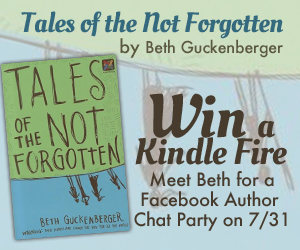
Celebrate with Beth by entering her Kindle Fire Giveaway and connecting with her
during the Author Chat Party on 7/31!

Find out what readers are saying here.


One winner will receive: 

  • A Kindle Fire with Wi-Fi
  • A Tales of the Not Forgotten small group kit (books and DVD)

Enter today by clicking one of the icons below. But hurry, the
giveaway ends on July 30th. Winner will be announced at the “Not Forgotten”
Author Chat Facebook Party on 7/31
. Beth will be hosting a book chat,
testing your trivia skills (how much do you know children around the world?) and
giving away some great prizes!


So grab your copy of Tales of the Not Forgoteen and join Beth on the evening
of the July 31st  for a chance to meet Beth and make some new friends. (If you
haven’t read the book – don’t let that stop you from coming!)


Don’t miss a moment of the RSVP today. Tell your
friends via FACEBOOK or TWITTER and increase your chances of winning. Hope to see you on the 31st!

*Disclosure of Material Connection: I received one or more of the products or services
mentioned above for free in the hope that I would mention it on my blog. Regardless, I
only recommend products or services I use personally and believe will be good for my readers.
I am disclosing this in accordance with the Federal Trade Commission’s 16 CFR, Part 255:
“Guides Concerning the Use of Endorsements and Testimonials in Advertising.”
Filed Under: Books, Reviews

« Previous Page
Next Page »
For God so loved the world that He gave His only begotten Son, that whoever believes in Him should not perish but have everlasting life.

For God did not send His Son into the world to condemn the world, but that the world through Him might be saved.

John 3:16-17 NKJV


< WOWBouquet’s Mother’s Day flower delivery – brighten Mom’s day with fresh blooms.

Get new posts by email:

<<Earth Day Deals Continue, Mother's Day Gifts Await — Save Up to 68% at Imarku!

Enter My Current Giveaway!


$10 Amazon Gift Card - ends 3/7 US

$75 Amazon Gift Card or Paypal Cash - ends 3/9 US CAN

$10 Amazon Gift Card - ends 3/14 US


Plexus Breast Chek Kit Take charge of your health! The Plexus Breast Chek Kit is designed for women to easily perform monthly self-examinations to help detect changes in their breasts.

Search


Archives

Categories

Momentum Influencer Network Member
Great American Pure Flix VIP Ambassador
WOWBouquet offers fast and reliable flower delivery for any celebration.

Designed By: Wacky Jacquis Designs